
Let’s face it, managing finances these days is a challenge. Everything feels more expensive, you have multiple accounts to manage, and unexpected expenses can impact your checking balance. But you don’t have to accept that overdraft fees are just part of regular banking. On the contrary, there are many steps you can take to successfully manage your money and greatly reduce the risk of overdraft fees.
Jefferson Security Bank can show you what you can do to create a plan, develop better habits, and stop pesky fees from hitting your account. Since the late 1800’s, we have been helping customers in West Virginia, Maryland and the surrounding areas realize their financial goals with personalized service and experts that are there to help. Because we’ve been in business for a while, we know how to navigate the rapidly changing banking landscape and give our customers the tools they need to succeed.
Overdraft Fees are More Common Than You Think
According to multiple sources, including from the Consumer Financial Protection Bureau (CFPB), more than a quarter of consumers (26.5%) have been hit with an overdraft fee at the average cost of $35. CFPB also confirms that may be due to high levels of financial vulnerability such as trouble paying basic bills and unexpected expenses. Taking control of your finances is key to not being the more than a quarter of consumers with a fee.
Different Types of Overdraft Protection
Many banks offer various types of overdraft protection, such as JSB Bounce Protection, for example. Knowing your options can help you select which option works best for your budget.
- Linked Accounts – automatically transfer funds from your savings account to cover overdraft expense
- Overdraft Line of Credit – this is a predetermined amount of credit that can be made available to customers with a checking account. The amount can vary and is based on a review of customer information including credit scores. Our JSB Personal Checking accounts can take advantage of an overdraft line of credit when you are approved for a line of credit with our lending team.
- Standard Overdraft Practices – at times, banks may choose to pay certain transactions and charge a fee if the customer doesn't have sufficient funds to cover the transaction.
A JSB Banking Professional is available at any time to review options, answer questions, and help you open a JSB Personal Checking account.

Budget, Budget, Budget!
It goes without saying that the first step to successfully managing your finances is to create and stick to a budget. It sounds easy, but can be challenging at times. The important thing is that you stick with it. Let’s take a look at some highlights from our blog How To Create A Budget, and recommend taking a deep dive into the content when you have a good amount of time to really pay attention.
50/30/20 Rule and Categorizing Expenses
It’s a tried and true rule of thumb for starting your budget, as many financial institutions and experts recommend it. He are the basics:
- 50% for essential needs like housing, utilities, groceries, and any expense that you consider essential
- 30% for entertainment, vacations, anything that is for fun and enjoyment
- 20% for long-term savings and paying off debt
Another helpful tip is to categorize all of your expenses to really understand where your money is being spent:
- Fixed expenses – items that do not fluctuate month-to-month such as a mortgage or car payment
- Variable expenses – these are things like groceries, utilities, transportation, and others
- Needs and Wants – just like the 50/30/20 rule, document what you have to pay versus what would be nice to have funds for
There are many additional steps and tips for creating a budget that works for you, and we encourage you to take a deep dive into our How To Create A Budget blog post.
Create a Safety Net with an Emergency Budget
While you may have allocated 20% to long-term savings, adding an Emergency Budget is an easy way to help cover unexpected expenses. In our Saving Should Be Your Biggest Expense blog post, financial guru Dave Ramsey outlines that you should save at least $1,000 as a baseline Emergency Budget, and gives tips for how to reach your goal faster. Having an Emergency Budget can be part of your plan to avoid overdrafts, particularly for larger transactions.
Schedule Bill Payments Strategically
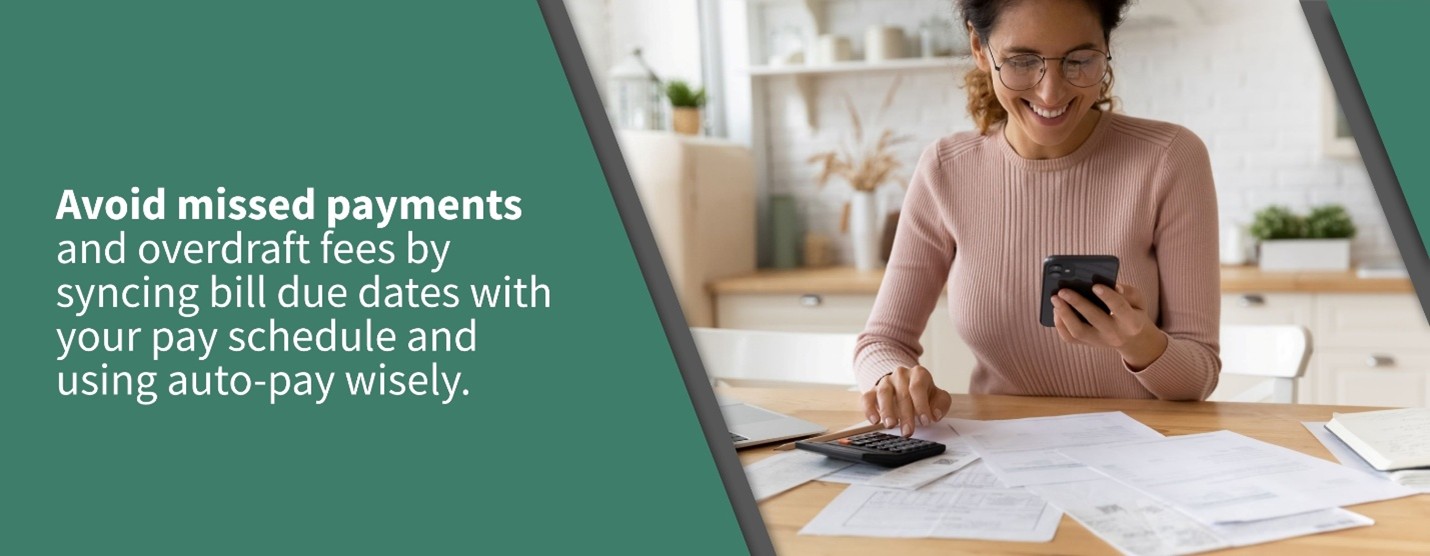
Once you’ve created your budget, it’s a good idea to review what expenses are in the 50% essential category. This will help you take a look at your budget, due dates of payments, and most importantly when you get paid so you can plan for when and which bills to pay.
Almost every company and service offer auto-pay features, which can be incredibly helpful for ensuring you don’t miss a due date. It also helps with sticking with your budget because you set-it-and-forget-it. Common expenses with auto-pay features include:
- Utilities (heating, electricity, internet, etc.)
- Mortgages
- Car payments
The trick to scheduling a bill payment is to pay attention to the expenses in your variable category, especially utilities. Knowing an expense may be higher than expected can let you temporarily turn off your auto-pay feature so you can avoid an overdraft fee and have a little more time to fully cover expenses.
Take Advantage of JSB Personal Checking Services to Avoid Overdraft Fees
Banking with JSB offers you all the features and benefits of global banks, but with a personal touch. Our JSB Personal Checking accounts give our customers powerful tools to manage their finances.
Online & Mobile Personal Banking
Checking your account on a regular basis should be a top priority to help you stick with a budget and spot a potential overdraft transaction and correct it before it hits your account.
When you activate Online Personal Banking and download the Mobile app, you have access to:
- Account management
- Money transfers to internal accounts
- Bill payments, including setting up auto-pay for certain accounts
- Debit card management
- Paperless statements
Set up Account Alerts
Don’t be surprised by low balances, large transactions hitting your account, or other transactions when you set up Account Alerts. You can select thresholds to know when your account dips below a set amount, giving you the heads-up to open your mobile app or online account to see activity.
Use our online financial management tool to put your money management into overdrive (and avoid overdrafts). Just like creating and sticking to a budget, JSB’s My Money Manager can help you:
- Manage your planned budget to stay on track
- Create categories for expenses
- Set short and long-term savings goals
- Make smarter financial decisions
Nothing is worse than accidentally misplacing your debit card, or worse yet having it stolen. If you don’t act fast, someone could drain your account quickly. You can quickly report a lost or stolen card from your mobile app and freeze your card and account until a replacement card can be sent.
Our Bounce Protection service offers up to $500 of coverage and is a feature of most of our checking accounts. Feel free to ask us for more details to find out if you are able to take advantage of Bounce Protection.
Make Jefferson Security Bank Your Trusted Banking Partner
Now that you know how to manage your money and steps to protect your account from overdraft fees, take the next step and open a JSB Personal Checking Account and activate all of our Additional Services.
Give us a call, visit us online, or come see us at one of our locations and let us help you take charge of managing your finances.